



What Watches Carry: A Memorial Day Reflection

Memorial Day weekend tends to bring people together — friends and family, cookouts, parades, ceremonies. Of course, it's a moment to think about the people who made that possible, those who gave their lives in service to their country.
Watches have a way of showing up in moments like this. More than almost any other object, they connect us: bridging generational gaps, linking people during life and after death. To me, a watch captures something of the person who wore it. At the very least, it holds memories, sometimes manifested as physical dings and scratches, patina, the particular wear that only comes from years on one person's wrist.
Keeps on Ticking

Rolex Oyster circa 1930. Image Source: Time Rediscovered
A well-made mechanical watch, serviced periodically, has no natural endpoint. The movement inside a 1930s Rolex Oyster is running somewhere right now, nearly 100 years after it left Geneva, on a wrist that may belong to the original owner's great-grandchild. Almost no other object in most people's lives behaves this way, with the exception of cars, especially with today's consumer goods. Clothing wears out. Furniture breaks down. A mechanical watch can simply continue.
What that means in practice is that a lot of watches get inherited. There's something about receiving a watch from someone who has died that is different from receiving their books or their furniture. The watch was on their body. It measured the time they spent. When you put it on, you're wearing the same object they wore, and it's still doing exactly what it was doing when they were alive.
Ask people how they first got into watches and a significant number will trace it back to a piece that came from a family member, often from someone who is gone — a grandfather's Submariner, a father's Day-Date, a mother's dress watch that spent decades in a jewelry box and came out looking nearly new. I've even written about a watch I inherited from my great-great-grandfather (gifted to me by his grandson; hi grandpa Dave!).
Always Read the Caseback
My great-great-grandfather's Hamilton Richmond, which I will be wearing all day.
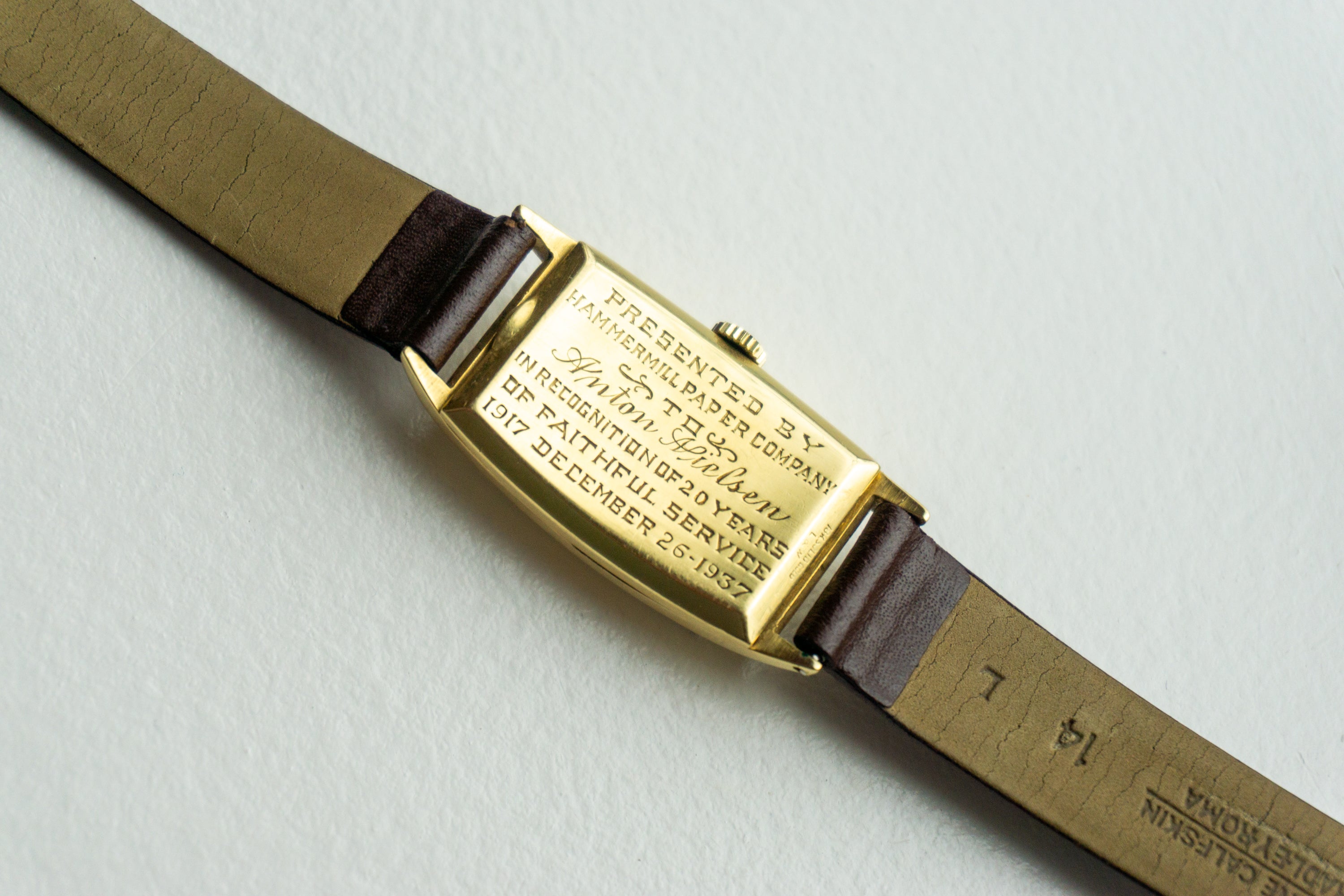
There's a lecture that's stuck with me — Cole Pennington, then an editor at Hodinkee, speaking at the Horological Society of New York in February 2020 about WWI and WWII military watches. His central argument was simple: always read the caseback. Most collectors flip a watch over to check the serial number and miss what's actually there. On military-issued pieces, what's there can be remarkable — a name, a date, a unit, sometimes a personal inscription from the people who sent a soldier off to war. An Elgin given to the heroic people of the USSR from Russian War Relief. Something stamped into steel so that, if the worst happened, someone would know whose watch it was.
Those details don't just tell you about the watch and where it was issued. They tell you about the person who wore it — who cared about them, what their life looked like, the relationships they carried with them. There's an idea that people keep living as long as someone is thinking about them. A watch makes that possible even between strangers, even across generations — which is exactly what Pennington found when he started reading the casebacks.
From All of Us at Everest
However you're spending this Memorial Day — with family, at a ceremony, or just taking a quiet moment — we hope it's a good one. From all of us at Everest, we're thinking of you today.


Leave a comment