



The COSC Just Launched a New Certification — 'Excellence Chronometer' Explained

The word "chronometer" carries real weight in the watch world: a watch movement that has been independently certified to meet the ISO 3159 standard, which requires accuracy within -4/+6 seconds per day across a rigorous 15-day battery of tests. The organization that administers those tests for Swiss watches is the COSC, the Contrôle Officiel Suisse des Chronomètres, and it has been doing so since the standard was established in 1976.

The COSC Building in La Chaux-de-Fonds, Switzerland. Image Source: COSC
COSC chronometer certification shows up across a remarkable range of price points. French independent Serica has a field chronometer for $1,100, and a Rolex Daytona, around $40,000, was tested to the same standard — and far beyond, but more on that in a second. Microbrands and independent watchmakers have increasingly pursued Chronometer certification as a way to signal quality in a crowded market. Around 40% of all Swiss mechanical watches exported today carry chronometer certification — a figure that speaks to how deeply embedded the standard has become in the fabric of Swiss watchmaking.
That ubiquity is both the COSC's greatest strength and, in recent years, the source of some outside pressure.
Certifications That Raised the Bar
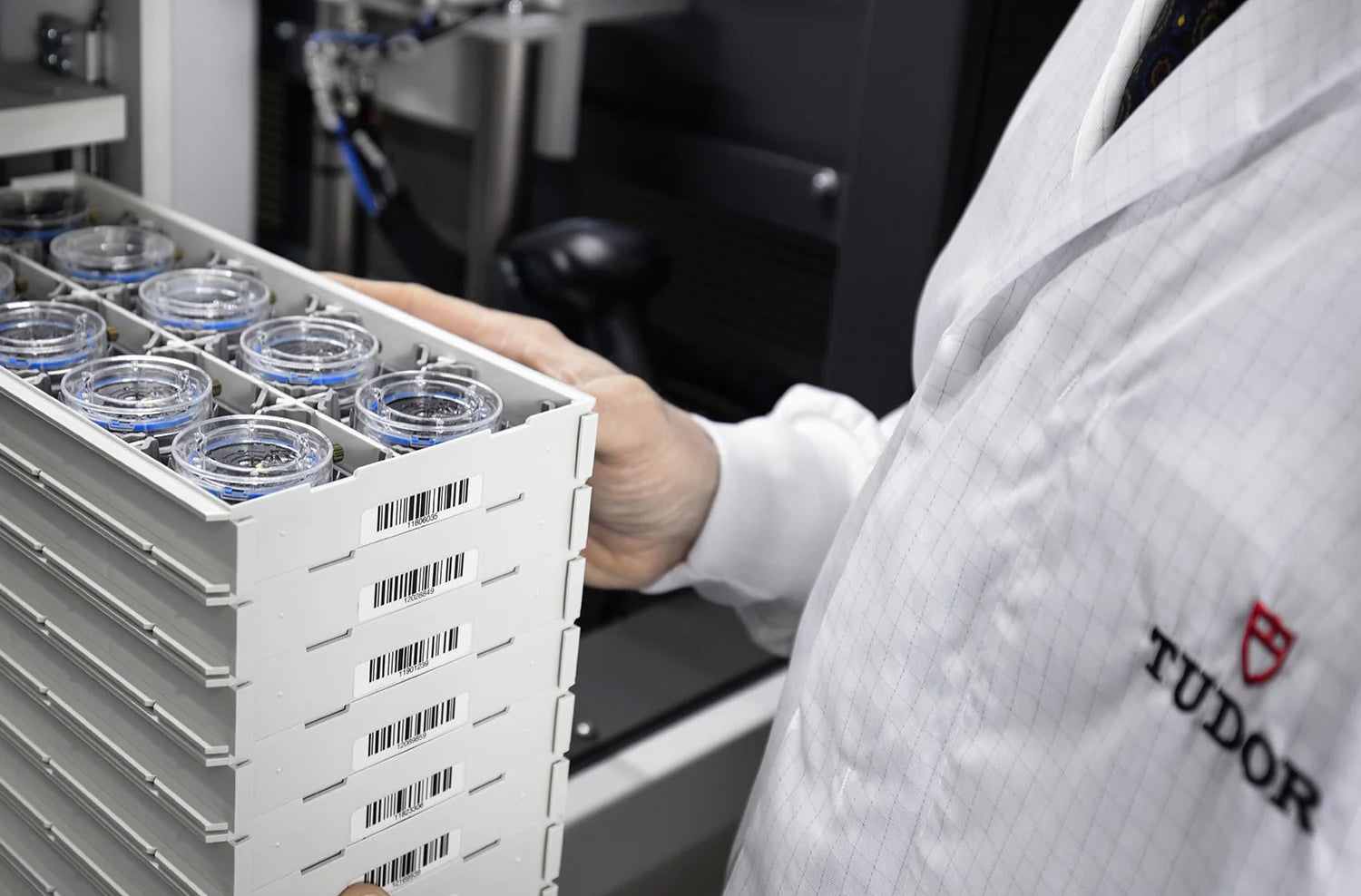
Inside Tudor's Manufacture. Image Source: Oracle Time
In 2015, Omega partnered with METAS — the Swiss Federal Institute of Metrology, a government body — to create the Master Chronometer certification. It's the most demanding independent third-party standard in the industry. METAS and the COSC are entirely separate institutions, but they share one important link: a movement must hold COSC chronometer certification before it can even be submitted for METAS testing. The COSC certifies the movement. METAS certifies the finished watch — independently, under its own governance.
METAS tests fully assembled, cased watches for magnetic resistance up to 15,000 Gauss, the equivalent field of an MRI machine. Accuracy is required within 0/+5 seconds per day, measured even after magnetization. Water resistance is tested at 25% above the watch's rated depth. Power reserve is verified at multiple charge levels. It's a genuinely comprehensive real-world stress test, and it's currently adopted by exactly two brands: Omega and Tudor.

Tudor Black Bay 68 'Master Chronmeter' Dial Text
The infrastructure required is significant — each certified brand needs a dedicated facility overseen by METAS staff. For most watchmakers, the economics simply don't work.
Rolex took a different route. Their proprietary Superlative Chronometer certification — conducted entirely in-house — holds finished watches to -2/+2 seconds per day, tighter than both the COSC and METAS on accuracy alone. It also includes water resistance and power reserve testing. It's not independent in the METAS or COSC sense, but no one should doubt the rigor behind it.
The picture that emerges: rigorous finished-watch testing has become available, and for some a non-negotiable, from sub-$5,000 watches to the very top of the market.
The COSC's Answer: Excellence Chronometer Certified

COSC Chronometer Certification Process. Image Source: Hodinkee
On February 12th, 2026 — the 50th anniversary of the ISO 3159 standard — the COSC announced a new certification tier: Excellence Chronometer Certified. It's framed as a complementary extension of the existing standard, not a replacement, and it picks up exactly where the old standard's limitations were most visible.
To earn it, a watch must first pass standard COSC Chronometer certification, then clear a second round of testing conducted on the fully cased, assembled watch. The additional criteria, as stated by the COSC:
- Tighter accuracy: -2/+4 seconds per day (down from -4/+6), tested on the finished watch
- Magnetic resistance: tested at 200 Gauss
- Power reserve: the stated power reserve is verified

Serica 6190 M.S.L. Chronometer Field Watch. Image Source: Hodinkee
Testing on the finished watch matters more than it might seem. Case geometry, gasket compression, the crown's proximity to the case — all of these affect how a movement performs in the real world versus on a test tray. The base COSC standard doesn't account for any of them.
The new certification runs approximately $33–$38 USD per watch (30–35 CHF), compared to roughly $11 for standard Chronometer certification — more than triple the cost. At that pricing, expect to see Excellence Chronometer pursued by brands in the $2,000+ range, where the certification fee makes sense for the marketing value. Rollout is planned for October 2026.
How Does an 'Excellence Chronometer' Actually Stack Up?

The standards aren't directly comparable — different institutions, different markets, different cost structures. But the numbers are worth examining.
On accuracy, -2/+4 s/day is a meaningful tightening over base chronometer standards, landing between a chronometer and what Rolex demands internally. On magnetic resistance, 200 Gauss is fine for everyday wear — but consider that the MagSafe magnet on the back of an iPhone generates a field of 1,500 to 2,500 Gauss. A 200 Gauss rating won't survive resting your watch on the back of your phone. METAS's 15,000 Gauss standard is a different category entirely. Water resistance testing is absent from Excellence Chronometer.

None of that is a knock on what the COSC has introduced. Excellence Chronometer isn't competing with METAS — it's offering the broader market a credible next step that doesn't require building a dedicated testing facility. The brands that stand to benefit most aren't Omega or Tudor; they're mid-market and independent makers who want to offer something more rigorous than base Chronometer certification.
The Legacy Player Makes Its Move

Inside COSC Laboratory. Image Source: COSC
The COSC has over 60 partner brands and certifies roughly 40% of all Swiss mechanical exports. Excellence Chronometer inherits all of that infrastructure and reach. These are different offerings serving different tiers of the market — Excellence Chronometer and METAS aren't in direct competition — but if this new standard sees even moderate adoption, its footprint will be substantial.
The real question is whether "Excellence Chronometer Certified" on a dial starts to mean something to collectors the way "Master Chronometer" does for Omega and Tudor. That's a marketing and perception challenge as much as a technical one. METAS set the blueprint. Rolex proved proprietary standards could be just as compelling. Now the COSC is offering a version of that logic at scale. Keep an eye on which brands sign on come October. That's where the story gets interesting.


Leave a comment