



Is Your Watch Too Big? Exploring the Modern Shift Toward Mechanical Density

Nearly four years ago, I sat down to write an article for The Everest Journal titled "Watch Sizes in the 21st Century (so far)." At the time, the industry was just starting to wake up from a twenty-year fever dream of oversized cases. I wrote about Arnold Schwarzenegger’s 64mm U-Boats and how Rolex had finally "corrected" the Explorer by shrinking it back to 36mm. I called it a "regression to the mean," but looking down at my wrist today, I realize I didn't see the full picture. I wasn't just witnessing a trend correction; I was witnessing a total shift in what we value in a timepiece.
The Charm of Mechanical Density

My 1950s Nivada Grenchen Croton Aquamatic 360EL
Right now, I’m wearing a 33mm Nivada Grenchen/Croton Aquamatic 360EL from the 1950s. By modern standards, some might call it tiny (despite its longer lugs that make it feel closer to 36mm), and by 2010 standards, it would have been dismissed as a lady's watch. But on the wrist, it is pure, concentrated charm. There is something inherently charming about a small mechanical watch. When you realize that a fully automatic movement—with its oscillating weight, hairspring, and complex gear train—is humming away inside a case no larger than a gold coin, the "engineering flex" becomes much more impressive than a 44mm slab of steel.
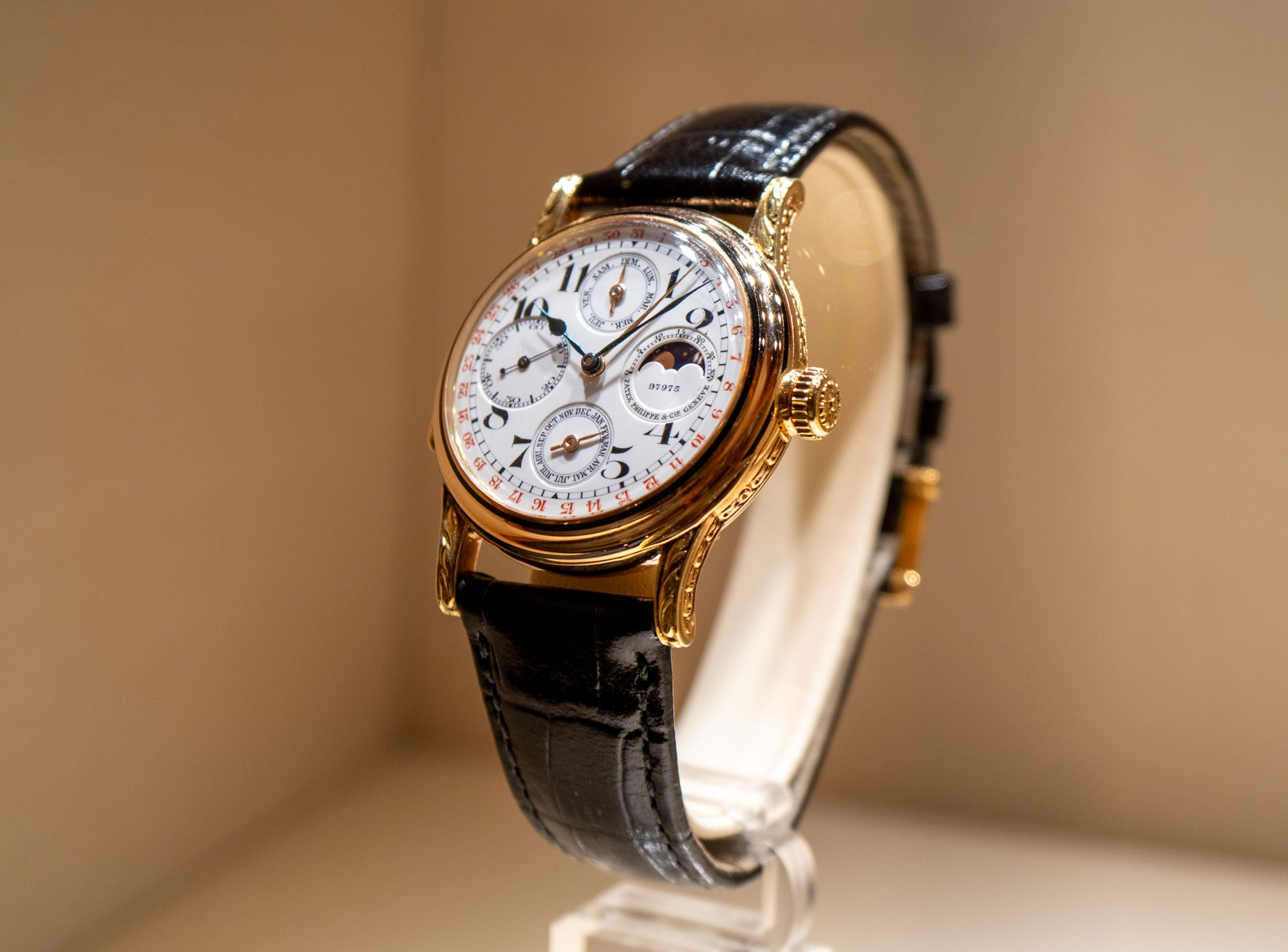
Patek Philippe 97975, seen at the Patek Philippe Museum
It’s about mechanical density—the same charm that defines a watch I’ve long been obsessed with and finally had the chance to see in person at the Patek Philippe Museum: the reference 97975. Dating back to 1925, it is the first-ever perpetual calendar wristwatch. The movement inside was originally created for a women's pendant watch in 1898 that never sold—or according to some lore, was never even made. After sitting for more than a quarter-century, the movement was recased into a hand-carved 34.4mm golden thing of beauty.

Patek Philippe 97975 Movement. Image Source: Revolution Watch
When you stop to consider the era, the existence of the 97975 is mind-boggling. To house a complication as temperamental and intricate as a perpetual calendar in a 34.4mm case in the 1920s was a feat of near-impossible miniaturization. Still today, major luxury watch brands struggle to create truly wearable perpetual calendar wristwatches, often resorting to 42mm+ cases just to fit the modules. Patek Philippe knocked it out of the park on the very first go. The 97975 marks the beginning of an era of beautifully proportioned icons, yet that specific pursuit of miniaturization has largely faded in modern watchmaking. We’ve spent the last few decades prioritizing "wrist presence" and visibility over the quiet, intense engineering required to make a watch small, complex, and elegant all at once.
The Non-Enthusiast Litmus Test

Perhaps the most telling evidence of this shift hasn't come from the forums or Instagram, but from the regular people in my life. Over the last few years, I’ve become the de facto "watch guy" for friends and family looking for their first real timepiece. Time and again, these men—most of whom don’t know anything about watches—ask for the same things. They tell me they don’t want anything too big, they want something elegant, and they especially don't want it to feel bulky or get in the way. For someone not used to the weight of a luxury watch, a 42mm diver feels like wearing a paper weight. A 36mm watch, however, feels like part of you.
Rolex and the Return to 36mm

Rolex is the master of the subtle pivot. After toying with the Explorer I’s sizing for over a decade, they famously brought back the 36mm version. It felt like a homecoming. But interestingly, they didn't just abandon the larger crowd; by eventually introducing a 40mm version alongside it, Rolex acknowledged that while 36mm is the soul of the Explorer, the "Big Watch" era left behind a legacy of enthusiasts who simply have larger wrists. We see this philosophy continuing into 2026 with the debut of the Land-Dweller, a model that pays homage to 1970s integrated-bracelet designs. By offering it in both 36mm and 40mm from day one, Rolex is signaling that the choice is no longer about the right size, but about the right fit for the individual.
Tudor and the Mastery of Proportion

Tudor Black Bay 54, Black Bay, and Black Bay 58 (left to right). Image Source: Watch Gecko
While Rolex was being cautious, Tudor decided to lead the charge. They didn't just shrink their watches; they refined the entire experience of wearing them. The Black Bay 54, at 37mm, is a masterclass in vintage proportions. It proved that you don't need a massive case to have a serious, 200m-water-resistant dive watch. This momentum hasn't slowed down. Just recently, Tudor expanded the Ranger collection to include a 36mm version alongside a new "Dune White" dial. It feels like a direct response to the purists who missed the tool watches of the mid-century. With the addition of the T-Fit clasp as a standard, Tudor has ensured that these smaller diameters don't just look better—they stay perfectly centered and comfortable all day.
Conclusion: Fit is King

Image Source: Tudor
If my first article was about the history of size, this one is about the feeling of size. We’ve moved past the era of watches as "wrist presence," which was often just code for being loud. We are now in the era of proportion. The 36mm Explorer mirrors its 1953 ancestor, and my 34mm vintage Croton feels like a hidden treasure, but both prove the same point: a watch doesn't need to be big to be bold. We have collectively moved past the idea that size equals substance. Sometimes, the most powerful thing a watch can do is disappear until you need it.


Leave a comment